SaaS platforms demand rigorous, scalable, and intelligent testing to ensure performance, security, and user satisfaction. With rapidly evolving cloud ecosystems, advanced testing methods that surpass traditional quality assurance are essential.
This guide offers an execution-focused SaaS testing framework to ensure reliability, scalability, and user experience across distributed environments.
Before diving deeper, let’s clarify the definition of SaaS testing.
SaaS testing is the process of validating cloud-based software applications hosted remotely and accessed via the internet. In contrast to traditional software, SaaS products operate in multi-tenant environments, demanding continuous validation across assorted configurations, users, and integrations.
We focus not only on functionality but also on performance, availability, scalability, and security under practical conditions.
Key Challenges in SaaS Testing
Multi-Tenancy Complexity
We must ensure that multiple users (tenants) can operate within the same environment without data leakage or performance degradation.
Steady Updates and Deployments
Frequent releases require automated regression testing pipelines to sustain stability.
Cross-Platform Support
Applications must work smoothly across devices, browsers, and operating systems.
Data Security and Compliance
Strict validation is required for data protection, encryption, and conformity with global standards.
Types of SaaS Testing
Functional Testing
We validate core features, workflows, and business logic to ensure correct behavior.
Performance Testing
We simulate heavy user loads to assess system responsiveness and stability.
Security Testing
We discover vulnerabilities, ensuring protection against unauthorized entry and data breaches.
Integration Testing
We verify smooth communication between APIs, third-party services, and internal modules.
Usability Testing
We evaluate user experience to ensure a user-friendly design and accessibility.
Disaster Recovery Testing
We validate system resilience and data restoration capabilities in failure scenarios.
SaaS Testing Architecture
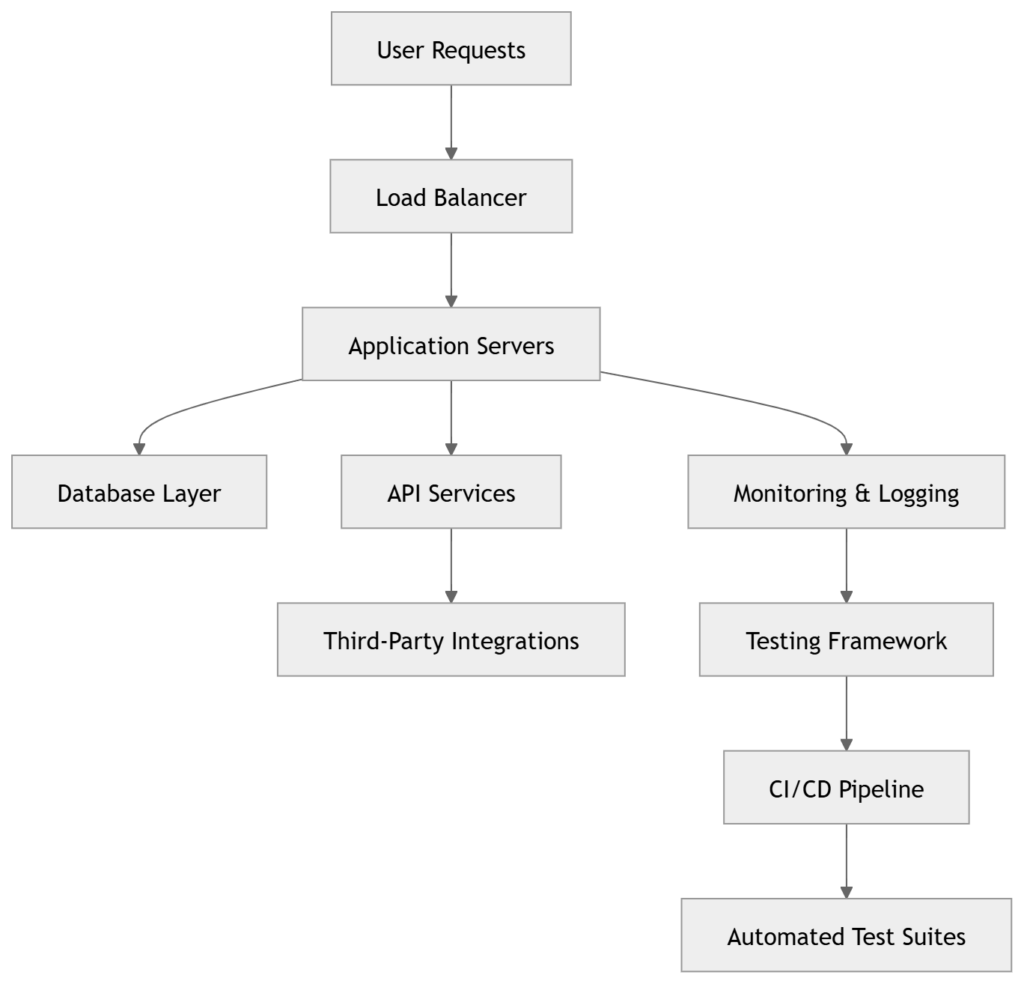
A strong SaaS testing architecture unites automation, cloud environments, and CI/CD pipelines.
Best Practices for Effective SaaS Testing
1. Implement Continuous Testing in CI/CD Pipelines
We integrate automated testing at every stage of the development lifecycle to detect faults early and accelerate delivery.
2. Prioritize Test Automation
Automation provides consistency and efficiency in repetitive testing scenarios such as regression, load, and API testing.
3. Use Scalable Cloud Test Environments
We use cloud infrastructure to model real-world conditions and simulate multiple user behaviors and workloads.
4. Focus on Security and Compliance
We conduct penetration testing, vulnerability scanning, and compliance audits to guarantee data integrity and privacy.
5. Adopt Multi-Tenant Testing Strategies
We validate tenant isolation, data validity, and resource provisioning across shared environments.
6. Monitor Real-Time Performance
We use monitoring tools to track system metrics and identify bottlenecks before they affect users.
7. Ensure API Reliability
We test all API endpoints for accuracy, latency, and fault tolerance to preserve seamless integrations.
8. Validate Backup and Recovery Mechanisms
We simulate failure scenarios to confirm fast data recovery and system restoration.
SaaS Testing Strategy Framework
Step 1: Requirement Analysis
We define testing objectives based on business goals and user expectations.
Step 2: Test Planning
We design a scalable testing roadmap and select tools and environments.
Step 3: Test Case Development
We create detailed test scenarios covering all functional and non-functional aspects.
Step 4: Test Execution
We execute automated and manual tests across multiple configurations.
Step 5: Reporting and Optimization
We analyze results, identify defects, and continuously improve testing efficiency.
To execute these strategies successfully, leverage top SaaS testing tools and metrics:
We track critical KPIs to measure testing effectiveness:
- Test Coverage
- Alongside tool usage, these advanced SaaS testing techniques further bolster quality:
We begin testing early in the development cycle to prevent costly defects.
AI-Powered Testing
We leverage machine learning to predict failures and optimize test coverage.
Chaos Engineering
We intentionally introduce failures to test system resilience and recovery.
Canary Testing
We release updates to a small user group before full deployment.
Security-First SaaS Testing Approach
We embed security testing throughout the lifecycle:
- Encryption validation
- Authentication and authorization checks
- Data leakage prevention
- Compliance validation (GDPR, HIPAA, etc.)
Conclusion
SaaS testing is a continuous, scalable, and intelligent process that ensures the security and reliability of cloud applications. By combining automation, monitoring, and advanced testing, we deliver resilient SaaS platforms that meet customer standards and outperform the competition.
Read More: Custom SaaS Development Solutions Built for Scalable Growth: 10 Powerful Strategies to Win Big
Frequently Asked Questions (FAQs)
What makes SaaS testing different from traditional software testing?
SaaS testing focuses on cloud environments, multi-tenancy, and continuous deployment, requiring increasingly dynamic and scalable testing approaches.
How often should SaaS applications be tested?
Testing should be continuous, integrated within CI/CD pipelines, and executed with every update.
Why is automation critical in SaaS testing?
Automation accelerates testing cycles, improves accuracy, and secures consistent quality across frequent releases.
What is the biggest risk in SaaS testing?
Security vulnerabilities and data breaches remain the most critical risks, demanding continuous validation and monitoring.
This guide delivers a blueprint for mastering SaaS testing and achieving top product quality in cloud environments.