A well-executed SaaS MVP Development Strategy is the smartest way to launch faster while minimizing risk and maximizing learning. By focusing on core value, validating assumptions early, and iterating based on real user feedback, founders and product teams can bring a functional product to market in weeks instead of months — all while staying lean and data-driven. This strategic approach not only accelerates time-to-launch but also ensures you build the right product that truly resonates with your target audience.
In today’s digital ecosystem, launching a successful SaaS product requires precision, speed, and strategic execution. We focus on building an MVP (Minimum Viable Product) to validate ideas quickly, minimize risks, and accelerate time-to-market. This strategy enables us to test assumptions, gather user feedback, and scale efficiently without wasting resources.
Our approach emphasizes lean development, iterative improvement, and customer-centric design, ensuring that every feature directly solves real user problems.
Understanding the Core of SaaS MVP Development
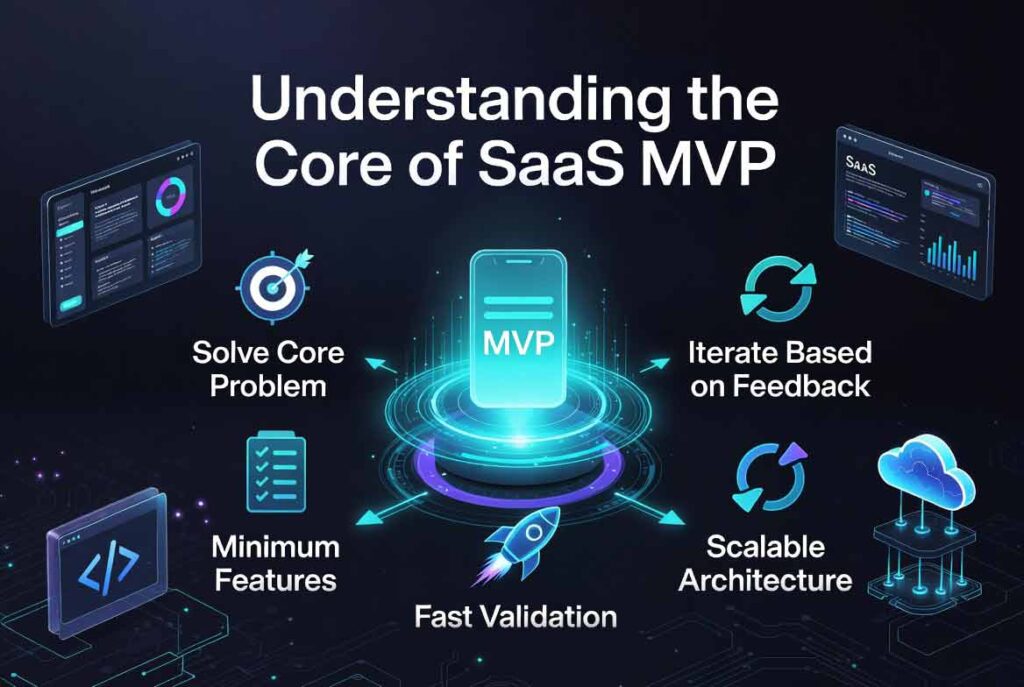
A SaaS MVP is not simply a basic product—it is a strategically built solution with essential features that deliver immediate value. We prioritize functionality, ensuring the product is usable, reliable, and scalable from day one.
Key characteristics include:
- Focused feature set targeting a specific problem
- Rapid deployment capabilities
- User feedback integration loops
- Scalable architecture for future growth
By aligning development with business goals, we build MVPs that are functional and market-ready.
Defining Clear Product Goals and Vision
We begin by establishing a clear product vision. This step ensures alignment among stakeholders, developers, and end users. A strong vision helps in:
- Identifying target audience segments
- Defining core problem statements
- Outlining unique value propositions
We remove ambiguity with clear, well-documented requirements, enabling faster cycles and reducing costly revisions.
Market Research and Competitive Analysis
Before development, we conduct in-depth research to understand user needs, trends, and competitors. This allows us to:
- Identify market gaps
- Discover untapped opportunities
- Position the MVP effectively.
We analyze competitor strengths and weaknesses to build a distinctive SaaS product.
Feature Prioritization Using the MVP Framework
We use a structured approach to prioritize features, including only critical functionalities in the MVP.
Must-Have Features
These are core functionalities without which the product cannot operate.
Nice-to-Have Features
Enhancements improve the experience but are not essential for launch.
Future Features
Advanced capabilities are for later stages.
This method ensures a lean build that reduces development time while maintaining product quality.
Choosing the Right Technology Stack
Choosing the right technology stack is vital for performance, scalability, and maintenance. We base our choices on:
- Project requirements
- Expected user load
- Integration needs
- Security standards
An optimized stack ensures fast deployment, seamless performance, and easy upgrades.
Agile Development for Faster Execution
We implement Agile methodologies to accelerate development. By breaking the project into smaller sprints, we achieve:
- Continuous progress tracking
- Faster iterations
- Early issue detection
- Improved collaboration
This approach allows us to refine the product while maintaining development speed.
UI/UX Design Focused on User Engagement
An MVP must function well and provide an intuitive experience. We design interfaces that are:
- Clean and user-friendly
- Responsive across devices
- Optimized for usability
User-centered design increases engagement and retention from launch.
Building a Scalable Architecture
Scalability is crucial for a successful SaaS MVP. We design systems that handle growth without requiring complete restructuring.
Our architecture includes:
- Cloud-based infrastructure
- Modular development practices
- API-first design approach
This ensures the product can scale as user demand increases.
Rapid Prototyping and Validation
Before full-scale development, we create interactive prototypes to quickly validate ideas. This helps in:
- Testing user flows
- Gathering early feedback
- Identifying usability issues
Prototyping reduces risk and ensures the final product aligns with user expectations.
Continuous Testing and Quality Assurance
We integrate continuous testing to ensure:
- Bug-free performance
- Security compliance
- Optimal functionality
Automated and manual testing deliver a reliable, stable MVP.
Launch Strategy for Maximum Impact
A successful MVP launch requires a well-planned strategy. We focus on:
- Targeted audience onboarding
- Beta testing programs
- Marketing alignment
Strategic launches help us gain early traction and validate the product effectively.
User Feedback and Iterative Improvement
After launch, we use feedback to refine the product. This involves:
- Monitoring user behavior
- Collecting customer insights
- Analyzing performance metrics
We implement improvements based on real data, evolving the product in the right direction.
Cost Optimization in SaaS MVP Development
Efficient resource management is key to a successful Saas MVP development. We optimize costs by:
- Reducing unnecessary features
- Using open-source technologies
- Implementing cloud solutions
This ensures maximum ROI while maintaining quality.
Security and Compliance Considerations
Security is a top priority in SaaS development. We implement:
- Data encryption protocols
- Secure authentication systems
- Compliance with industry standards
This builds user trust and protects sensitive data.
Scaling Beyond the MVP
Once the MVP is validated, we focus on scaling the product by:
- Adding advanced features
- Expanding market reach
- Enhancing performance capabilities
This transition turns the MVP into a SaaS solution capable of long-term success.
Common Mistakes to Avoid in SaaS MVP Development
We avoid pitfalls that can delay or derail the project, such as:
- Overloading the MVP with too many features
- Ignoring user feedback
- Poor market research
- Lack of scalable infrastructure
Addressing these challenges early ensures a smooth development journey.
Conclusion: Building Smarter, Launching Faster
A strong SaaS MVP strategy enables us to launch products faster and more efficiently. By focusing on core functionality, user needs, and scalability, we create solutions ready to grow and adapt in a dynamic market.
If you’re ready to accelerate your SaaS MVP journey or want tailored strategic support, connect with us today. Let’s launch your next big SaaS idea smarter and faster—reach out now to get started.