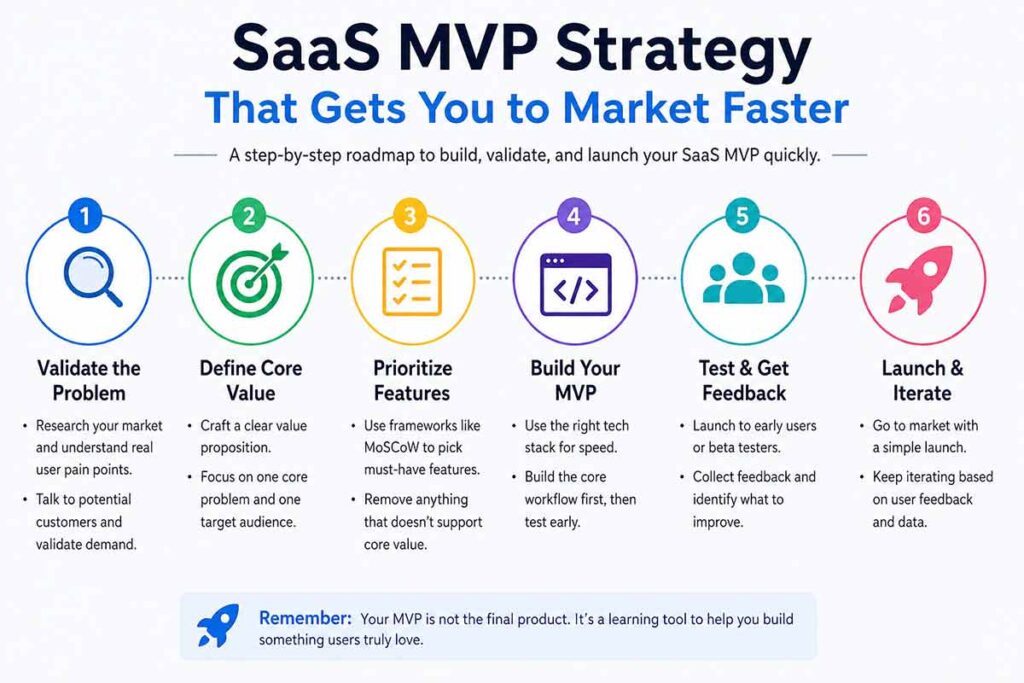
Speed is the ultimate currency in SaaS. The faster you reach real users, the faster you learn if you’re building something valuable or just another roadmap idea. In today’s competitive landscape, waiting six months to launch an MVP can mean the difference between success and irrelevance. Many founders now aim for lean MVPs that can be tested within weeks, as modern tools and AI-powered workflows reshape development speed.
The harsh reality is that most SaaS startups don’t fail because they lack ideas. They fail because they build too much before validating anything. Overbuilding drains time, money, and motivation. A fast SaaS MVP strategy flips this mindset on its head. Instead of asking “What features should I add?”, you start with “What is the smallest version that solves one real problem?” That shift alone can cut your time-to-market dramatically and keep your focus sharp.
Understanding What a SaaS MVP Really Is
A SaaS MVP (Minimum Viable Product) is not a partially completed product or a rough prototype. It is a functional, usable version of your software that solves one specific problem for a defined audience. The keyword here is viable, meaning it must actually deliver value, even if it’s simple.
Many founders think an MVP just means a simple version of everything, but that often leads to bloated, ineffective products. In reality, a SaaS MVP should cover one workflow, one user type, and one measurable outcome. The MVP is for validation, not perfection or extensibility.
The difference between a prototype and an MVP is also important. A prototype demonstrates an idea. A SaaS MVP proves market demand. A full product, on the other hand, is optimized for growth and scale after validation. If you blur these lines, you risk wasting months building features nobody actually needs.
Core Principles of a Fast-to-Market MVP Strategy
Speed in SaaS isn’t about rushing—it’s about clarity. The fastest MVP strategies follow a few core principles that eliminate unnecessary work and keep development laser-focused.
The first principle is to focus on one core problem. If your SaaS tries to solve multiple problems at once, it automatically slows down development and confuses users. The fastest MVPs are built around a single pain point users frequently experience.
The second principle is built for validation, not perfection. Your MVP doesn’t need advanced dashboards, complex automation, or polished UI. It needs enough functionality to answer one question: do users care?
The third principle is to focus on our learning rather than on scaling. Early SaaS success isn’t measured by architecture or performance—it’s measured by how quickly you can learn from real user behavior. This change in mindset reduces unnecessary engineering effort and greatly accelerates market entry.
Market Research Before Building Your MVP
Skipping research is one of the fastest ways to waste time in SaaS development. Before writing a single line of code, you need to understand who you are building for and what problem they desperately want solved.
Start with user pain points. These are not assumptions; they are real frustrations expressed by potential customers. Interviews, forums, and competitor reviews can quickly expose patterns. The goal is to identify problems that people are already trying to solve inefficiently.
Next comes competitor gap analysis. Instead of copying competitors, you look for what they are missing. Maybe their product is too complex, too expensive, or too slow. That gap becomes your MVP opportunity.
Good research guarantees that your MVP is not just fast to build but also relevant to the market from day one.
Read More: SaaS Roadmap
Defining Your SaaS Value Proposition
Your SaaS MVP must communicate its value in one clear sentence. If you can’t explain what your product does in under 10–12 words, your strategy is already too complicated.
A strong value proposition answers three questions instantly: what problem it solves, who it solves it for, and why it is better than alternatives. This lucidity is essential because early users don’t have patience for confusion.
For example, instead of saying “an AI-powered productivity platform for teams,” a better MVP statement would be “automates task monitoring for small remote teams.” The second version is sharper, more focused, and easier to validate.
Feature Prioritization Framework
Feature overload kills MVPs. More features mean slower development and weaker focus, not more value.
A simple way to rank is the MoSCoW method:
- Must have: core functionality needed for MVP success
- Should have: important but not essential features
- Could have: enhancements for later
- Won’t have: unwanted distractions
Your MVP should primarily include “must-have” features. Everything else belongs to future versions.
Choosing the Right Tech Stack for Speed
Your tech stack directly affects how quickly you reach the market. Today, founders have three main paths: no-code tools, low-code platforms, and custom development.
No-code tools are the fastest but are limited in scalability. Low-code delivers a balance between speed and flexibility. Custom builds take longer but provide long-term control. Many modern SaaS MVPs use a mix of approaches depending on complexity.
The key is not choosing the “best” stack but choosing the fastest stack that won’t block your next 12–18 months of growth.
Lean SaaS MVP Development Process
A lean development process focuses on rapid iteration instead of long planning cycles. Agile sprints work best here, allowing you to build, test, and improve continuously.
Start by building the core workflow first—the exact action users came for. Do not add dashboards, settings, or integrations until the core loop is working.
Then move into rapid iteration cycles, where each version improves based on user feedback. This approach secures you never drift away from real user needs.
Using AI to Accelerate MVP Development
AI has changed SaaS development dramatically. Founders now use AI tools to generate code, design interfaces, and even simulate user behavior before launch.
AI can greatly shorten development time, especially in early-stage MVPs where speed is critical. It also helps analyze feedback and discover patterns faster than manual methods.
However, AI should support decision-making, not replace product thinking. The strategy still needs human clarity.
User Testing and Early Feedback Loops
An MVP without feedback is just a guess. Early testing is where real validation happens.
Beta users should be small, targeted, and highly relevant to your niche. Their feedback is more valuable than broad-scale surveys because it reflects actual usage behavior.
The goal is to identify friction points quickly and adjust your MVP prior to scaling further.
Go-To-Market Strategy for SaaS MVP
Your go-to-market strategy should start before your product is fully built. Early traction comes from simple channels like personal outreach, niche communities, and waitlists.
Instead of broad marketing, focus on a single user segment and a single channel. This increases conversion and reduces wasted effort.
Common MVP Mistakes to Avoid
The biggest mistakes include overbuilding features, ignoring user feedback, and trying to scale too early. Each of these slows down validation and delays learning.
Metrics That Matter for SaaS MVP Success
The most important metrics are activation rate and retention. If users don’t come back, your MVP hasn’t solved a real problem.
Scaling After MVP Validation
Scaling should only happen after strong validation signals. That includes consistent usage, retention, and willingness to pay.
Conclusion
A fast SaaS MVP strategy is not about cutting corners—it’s about cutting waste. The goal is to reach real users as quickly as possible so you can learn what actually works in the market. When you focus on clarity, simplicity, and validation, speed becomes a natural outcome rather than a struggle.
FAQs
1. How long should a SaaS MVP take to build?
Typically between 2 and 8 weeks, depending on complexity and tools used.
2. What is the biggest mistake in SaaS MVP development?
Building too many features before testing the core idea.
3. Should I use no-code tools for my MVP?
Yes, if speed is your priority and your product is simple.
4. How do I know if my MVP is successful?
Look for end-user engagement, retention, and willingness to pay.
5. When should I scale my SaaS MVP?
Only after consistent user demand and proven product-market fit.