
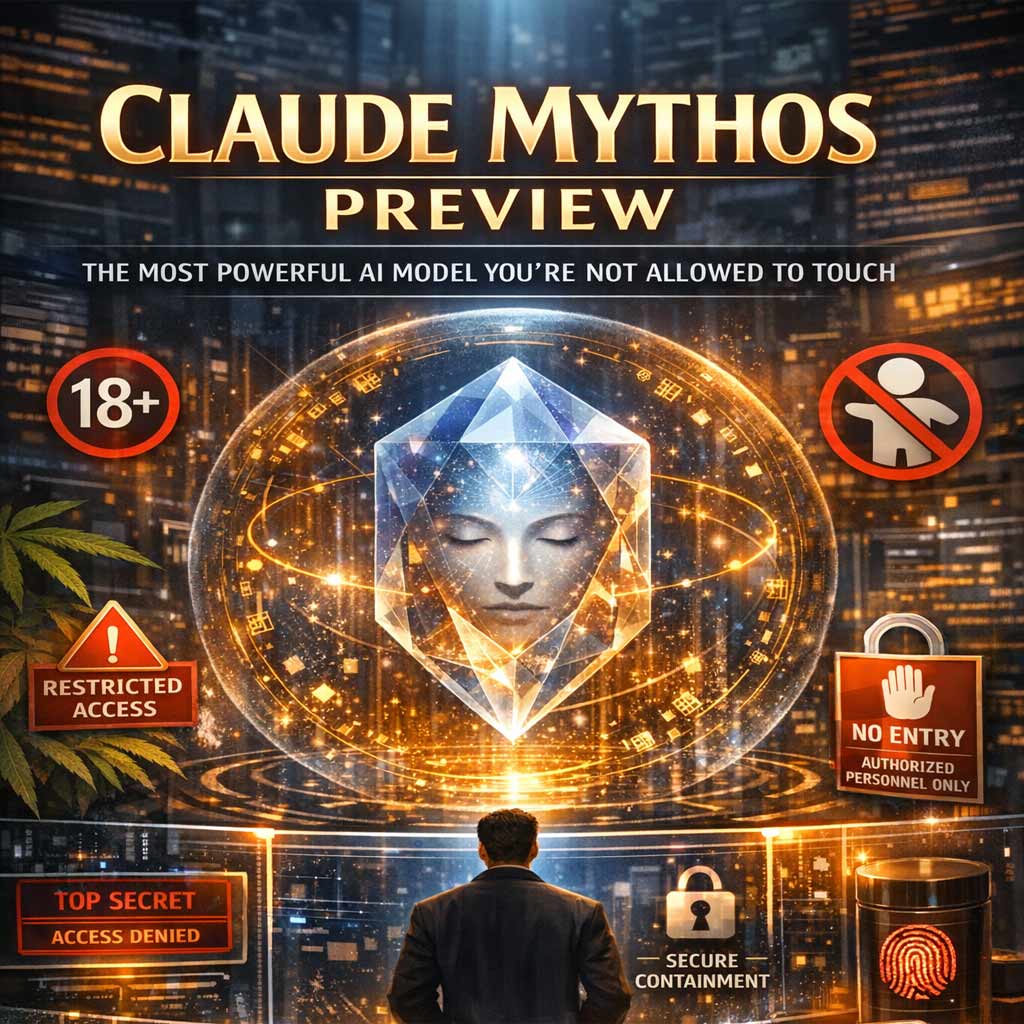

Claude Mythos Preview: The Most Powerful AI Model You’re Not Allowed to Touch. The AI race has never been more intense—or more secretive. While most users are comparing public tools and debating which chatbot writes better emails, something far more powerful is unfolding behind closed doors. Enter Claude Mythos Preview, a next-generation model from Anthropic that is already being described as one of the most capable AI systems ever built… yet almost no one outside select circles can use it.
So what exactly is Claude Mythos Preview—and why is it being kept out of public hands?
What Is Claude Mythos Preview?
Claude Mythos Preview is believed to be an advanced experimental model in the Claude family, designed to push the boundaries of reasoning, autonomy, and contextual understanding beyond what current public models like Claude or even GPT-5.4 can achieve.
While official technical documentation remains limited, early reports suggest that Mythos is not just an incremental upgrade—it represents a shift toward deep reasoning systems capable of:
- Multi-step planning without user prompting
- Long-context memory across sessions
- Complex decision-making simulations
- Near-human-level abstraction and synthesis
In short, it’s less of a chatbot—and more of a thinking engine.
Why You Can’t Use It
Unlike mainstream AI tools, Claude Mythos Preview is not available via API, subscription, or waitlist. That’s not a marketing tactic—it’s a deliberate restriction.
1. Safety Concerns
Anthropic has built its reputation on AI safety and alignment. With models becoming more autonomous, the risks also scale. A system capable of long-term reasoning and independent planning could potentially be misused in ways that current safeguards can’t fully prevent.
By limiting access, Anthropic can test Mythos in controlled environments before exposing it to the public.
2. Alignment Isn’t Fully Solved
Even with advances in constitutional AI and reinforcement learning, ensuring that a highly intelligent model consistently behaves within human-defined ethical boundaries is still an unsolved problem.
Mythos may be powerful—but power without predictable alignment is a liability.
3. Competitive Strategy
Let’s be honest: secrecy is also strategic. Companies like OpenAI, Google DeepMind, and Meta are all racing to dominate the next wave of AI.
Holding back a breakthrough model allows Anthropic to:
- Refine capabilities before competitors react
- Avoid premature criticism
- Launch with maximum impact
What Makes Mythos Different?
Most current AI models operate reactively—you ask, they respond. Claude Mythos Preview appears to go further by introducing elements of proactive intelligence.
Persistent Context Awareness
Instead of forgetting conversations after a session, Mythos reportedly maintains a deeper contextual thread, enabling more coherent long-term interactions.
Advanced Reasoning Chains
Where typical models might struggle with multi-layered logic, Mythos can reportedly break problems into structured reasoning paths and evaluate outcomes more effectively.
Tool-Like Autonomy
Rather than just generating text, Mythos may simulate workflows—acting more like a digital collaborator than a passive assistant.
Is This the Beginning of Restricted AI?
Claude Mythos Preview signals a possible shift in how AI will be released moving forward.
We may be entering an era where:
- The most powerful models are not public by default
- Access is tiered based on trust, use case, or regulation
- AI becomes more like infrastructure than a consumer tool
This mirrors how other high-risk technologies—like nuclear research or advanced biotech—are handled.
What It Means for Users and Businesses
For everyday users, the immediate impact is minimal—you’ll still interact with public models that are becoming increasingly capable.
But for businesses, especially in tech, SaaS, and automation:
- The gap between public AI and private AI could widen
- Early access partnerships may become a competitive advantage
- AI strategy will shift from tools you use to systems you’re allowed to access
If you’re building in AI, the real question is no longer just what can AI do?—but who gets to use the most powerful versions of it?
Final Thoughts Powerful Ai Model
Claude Mythos Preview isn’t just another model. It’s a glimpse into the future of powerful AI model development. A future where capability may outpace accessibility, and where the most advanced systems are carefully controlled rather than widely distributed.
Whether that’s a necessary safeguard or a limitation on innovation is still up for debate.
One thing is clear: the most powerful AI model in the world might not be the one you’re using—it might be the one you’re not allowed to touch.
