Modern Software-as-a-Service platforms leverage scalable, resilient, and secure cloud infrastructure to guarantee uninterrupted digital experiences. As businesses progressively adopt subscription-based software models, they optimize cloud environments to maintain uptime, support global users, and accelerate product innovation.
Cloud infrastructure for SaaS products goes beyond hosting applications online. It forms a complete ecosystem, including servers, databases, storage, networking, security layers, APIs, monitoring, and automation tools. These components collaborate to deliver strong performance.
Organizations that commit to robust cloud architecture gain a competitive advantage by scaling more effectively, cutting operational costs, improving security, and deploying faster.
Comprehending the Core Elements
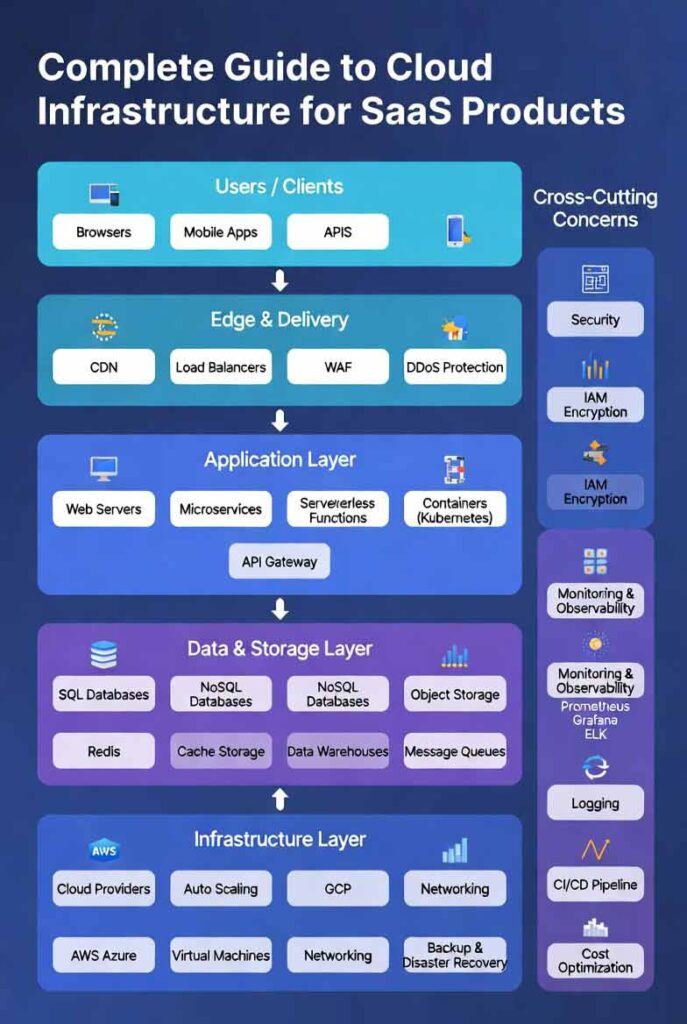
Grasping the core elements of cloud infrastructure for SaaS products is important for effective planning and execution.
Cloud infrastructure combines virtualized computing resources to support SaaS applications. Cloud providers deliver these resources. Examples are:
A SaaS cloud infrastructure typically includes:
- Virtual machines
- Containers and orchestration
- Cloud storage systems
- Load balancers
- Content distribution networks
- Managed databases
- Safety frameworks
- Monitoring and logging tools
- CI/CD release pipelines
These components ensure SaaS products remain highly available, responsive, and able to handle fluctuating trafficments.
Core Components of SaaS Cloud Infrastructure
1. Compute Resources
Compute resources form the foundation of every SaaS application. Cloud providers provide elastic virtual machines and container orchestration platforms to efficiently run application workloads.
Virtual Machines
Virtual machines provide isolated environments for quick application deployment. There is no have to maintain physical hardware.
Benefits include:
- Flexible scaling
- Cost efficiency
- Resource isolation
- High availability
Containers and Kubernetes
Containerization has transformed SaaS deployment. Technologies such as Docker and Kubernetes enable lightweight, portable applications. These applications scale rapidly.
Advantages include:
- Faster deployments
- Improved portability
- Productive resource utilization
- Simplified DevOps workflows
Read more: AI & Machine Learning Solutions
2. Cloud Data Storage
SaaS products process large volumes of user data daily. Cloud object storage solutions provide secure and scalable infrastructure for storing both structured and unstructured datasets.
Object Storage
Object storage platforms are ideal for:
- Media files
- Backups
- User uploads
- Analytics datasets
Block Storage
Block storage is commonly used for:
- Databases
- Operating systems
- High-performance workloads
File Storage
File storage supports:
- Shared file systems
- Team collaboration
- Legacy applications
Efficient storage improves the speed at which applications respond. It also helps with disaster recovery.
3. Database Infrastructure
Databases are central to SaaS platforms. Choosing the optimal database architecture influences throughput, scalability, and fault tolerance.
Relational Databases
Relational databases remain popular for transactional SaaS platforms.
Examples include:
- MySQL
- PostgreSQL
- Microsoft SQL Server
These databases provide:
- ACID compliance
- Structured schema management
- Reliable transactions
NoSQL Databases
NoSQL solutions support extremely scalable applications. These are useful when dealing with vast amounts of distributed data.
Common choices include:
- MongoDB
- Cassandra
- DynamoDB
Benefits include:
- Horizontal scalability
- Flexible schemas
- High-speed performance
4. Networking Infrastructure
Networking controls how users reach SaaS applications anywhere in the world.
Load Balancers
Load balancers distribute traffic evenly across servers to prevent downtime and bottlenecks.
Key benefits:
- Enhanced availability
- Decreased latency
- Traffic optimization
Content Distribution Networks (CDNs)
CDNs cache content nearer to users worldwide, improving application speed.
Advantages include:
- Faster page loading
- Reduced server strain
- Improved worldwide accessibility
Virtual Private Clouds (VPCs)
VPCs build isolated cloud environments, improving security and boosting network segmentation.
Benefits of Cloud Infrastructure for SaaS Companies
Scalability
Cloud infrastructure enables SaaS providers to dynamically scale resources in response to user demand.
This flexibility permits businesses to:
- Handle traffic spikes
- Expand globally
- Support millions of users.
- Reduce downtime risks
Cost Optimization
Traditional infrastructure needs large investments in hardware and maintenance. Cloud platforms eliminate these costs through pay-as-you-go pricing.
Businesses save costs on:
- Hardware procurement
- Data center maintenance
- Energy consumption
- IT staffing
High Availability
Cloud providers use a distributed infrastructure throughout regions. This ensures business continuity.
Features include:
- Multi-region deployments
- Automated failover
- Redundant storage
- Backup systems
Faster Time-to-Market
Cloud-native infrastructure speeds up product development and deployment.
Development teams benefit from:
- Automated deployments
- Continuous integration
- Infrastructure-as-code
- Rapid testing environments
Security in SaaS Cloud Infrastructure
Security is critical for SaaS operations. Secure cloud infrastructure protects sensitive customer data and supports regulatory compliance.
Identity and Access Management (IAM)
IAM systems control user permissions and authentication steps.
Best practices include:
- Multi-factor authentication
- Permission-based access controls
- Least privilege policies
Data Encryption
Encryption keeps data secure both when stored and during transfer.
Critical encryption areas include:
- Database encryption
- SSL/TLS certificates
- Backup encryption
Compliance Standards
SaaS companies often require conformity with industry regulations, such as:
- GDPR
- HIPAA
- SOC 2
- ISO 27001
Cloud providers offer infrastructure ready for compliance. This makes meeting regulations easier.
Cloud Deployment Models for SaaS
Public Cloud
Public cloud platforms adopt shared infrastructure, managed by third parties.
Benefits include:
- Lower operating expenses
- Fast deployment
- Unlimited scalability
Private Cloud
Private cloud environments give dedicated infrastructure. This fits organizations with strict security needs.
Advantages include:
- Augmented control
- Increased customization
- Better compliance
Hybrid Cloud
A hybrid cloud combines public and private environments for maximum flexibility.
This model supports:
- Workload optimization
- Disaster recovery
- Safe data handling
DevOps and Automation in SaaS Infrastructure
Automation is now essential for running efficient SaaS operations.
Infrastructure as Code (IaC)
IaC tools automate how teams set up and manage cloud resources.
Popular tools include:
- Terraform
- Ansible
- CloudFormation
Benefits include:
- Decreased manual errors
- Faster deployments
- Improved consistency
Continuous Integration and Continuous Deployment (CI/CD)
CI/CD pipelines automate software testing and release steps.
Main advantages:
- Rapid feature delivery
- Improved code quality
- Faster bug fixes
Monitoring and Performance Improvement
Monitoring tools offer real-time visibility into the performance of cloud infrastructure.
Application Monitoring
Monitoring platforms track:
- CPU usage
- Memory consumption
- Response times
- Error rates
Log Management
Centralized logging helps teams fix issues fast and keep systems reliable.
Auto Scaling
Auto-scaling tools add or remove resources as traffic changes. This preserves performance.
Disaster Recovery and Backup Strategies
Reliable disaster recovery plans are essential for SaaS continuity.
Automated Backups
Frequent backups protect against:
- Data corruption
- Equipment breakdowns
- Cyberattacks
Multi-Region Replication
Replicating data across multiple regions boosts fault tolerance and reduces downtime.
Recovery Time Objectives (RTO)
Recovery goals help businesses restore service quickly after a disruption.
Emerging Trends in SaaS Cloud Infrastructure
Serverless Computing
Serverless architecture eliminates the need for server management, permitting developers to focus entirely on application logic.
Benefits include:
- Lower operating overhead
- Automatic scaling
- Reduced infrastructure complexity
Artificial Cognitive Integration
AI-driven infrastructure management improves:
- Predictive maintenance
- Threat detection
- Resource optimization
Best Practices for Building SaaS Cloud Infrastructure
Design for Scalability
Applications should be built to support horizontal scaling from the start. This allows future growth.
Implement Zero Trust Security
Zero-trust models verify every user and device before granting access.
Use Managed Services
Managed cloud services with lower maintenance work. They also improve efficiency.
Refine Resource Usage
Regular infrastructure checks stop overprovisioning. They also cut cloud costs.
Prioritize Monitoring
Continuous monitoring lets teams find faults early and respond faster.
How to Choose the Right Cloud Provider
Selecting the right cloud platform depends on a number of factors:
- Pricing structure
- Global availability
- Security features
- Compliance support
- Integration functions
- Managed services
- Technical support
Organizations must evaluate providers to support long-term growth and functional needs.
Future of Cloud Infrastructure for SaaS Products
The future of SaaS infrastructure will focus heavily on:
- AI-powered automation
- Hyper-scalability
- Sustainable cloud computing
- Edge-native architectures
- Enhanced network security frameworks
Businesses implementing modern cloud-native strategies will achieve faster innovation cycles and greater business efficiency.
Ready to Build a High-Performance SaaS Product?
Work with a trusted SaaS development company to create scalable, secure, and user-friendly software. From idea validation to deployment, our experts build custom SaaS applications that fuel growth and enhance customer experience.
Why Choose Our SaaS Development Services?
- Custom SaaS application development
- Cloud-native architecture
- Scalable and secure solutions
- Agile development process
- Ongoing maintenance and support
Get Started Today
Turn your business idea into a powerful SaaS platform. Contact our team for a free consultation. Accelerate digital growth with innovative SaaS solutions.
Conclusion
Cloud infrastructure forms the foundation of successful SaaS products. A well-designed architecture improves scalability, bolsters security, increases performance, and accelerates innovation. By applying advanced cloud technologies, automation tools, and solid security frameworks, SaaS companies can deliver reliable digital experiences to users worldwide.
Organizations that invest in scalable cloud ecosystems position themselves for long-term growth, operational durability, and competitive advantage in the rapidly evolving software industry.