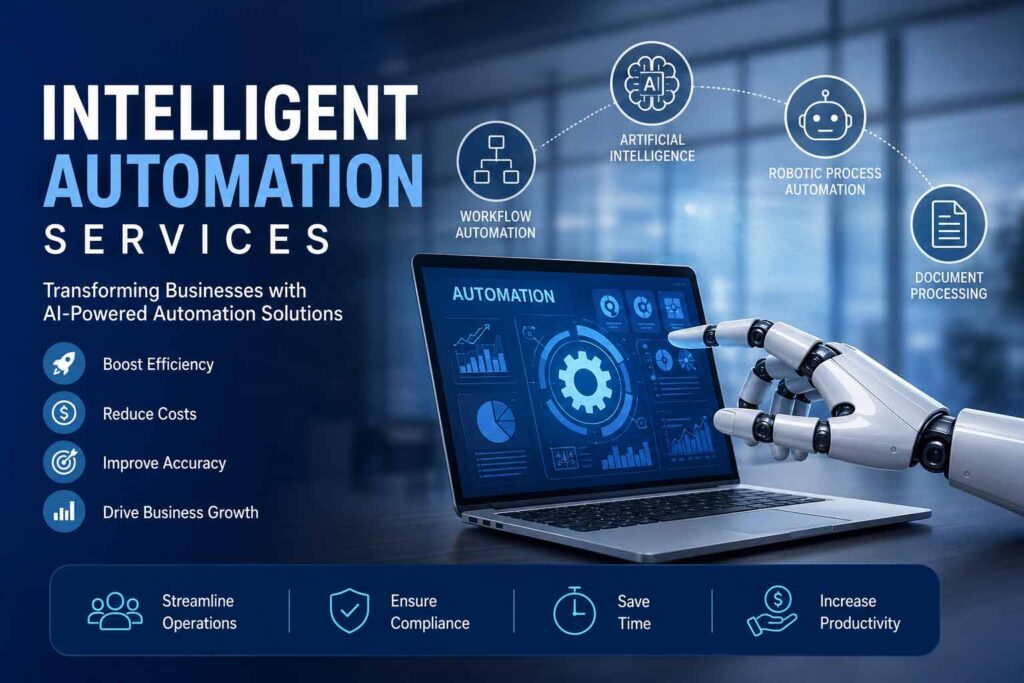
Businesses today demand speed, precision, scalability, and operational efficiency. Traditional workflows cannot keep pace with increasing customer expectations and digital transformation initiatives. Intelligent automation services bridge that gap by combining robotic process automation, artificial intelligence, machine learning, and workflow orchestration into a unified operational framework.
We help organizations automate repetitive tasks, streamline business operations, reduce operational costs, and unlock scalable productivity through advanced automation strategies tailored to real-world business challenges.
What Are Intelligent Automation Services?
Intelligent automation services combine software-driven automation with cognitive technologies to perform tasks traditionally handled by humans. These services eliminate manual bottlenecks, improve process accuracy, and create faster decision-making systems across departments.
Unlike basic automation scripts, intelligent automation solutions integrate:
- Robotic Process Automation (RPA)
- Artificial Intelligence (AI)
- Machine Learning (ML)
- Natural Language Processing (NLP)
- Business Process Management (BPM)
- Intelligent Document Processing (IDP)
- Predictive Analytics
- Cloud Automation
The result is an interconnected digital ecosystem capable of handling high-volume operations with minimal human intervention.
Learn how scalable cloud software evolves from concept to deployment with this detailed guide: SaaS Product Development Lifecycle
Core Components of Enterprise Automation Solutions
Robotic Process Automation (RPA)
RPA automates rule-based repetitive tasks such as:
- Data entry
- Invoice processing
- Payroll operations
- Customer onboarding
- Email handling
- CRM updates
- Report generation
RPA bots mimic human actions within digital systems while operating continuously without fatigue or inconsistency.
Key Benefits of RPA
| Benefit | Impact |
|---|---|
| Faster Operations | Processes completed in seconds |
| Cost Reduction | Lower labor and operational costs |
| Improved Accuracy | Reduced human error |
| Scalability | Handle growing workloads easily |
| Compliance | Consistent audit-ready processes |
Artificial Intelligence Integration
AI-powered automation expands beyond repetitive tasks and introduces intelligent decision-making capabilities.
AI Automation Capabilities
- Predictive forecasting
- Sentiment analysis
- Fraud detection
- Smart recommendations
- Chatbot automation
- Voice recognition
- Customer behavior analysis
AI systems continuously learn from data patterns, making automation smarter over time.
Explore proven growth techniques for automation-focused SaaS businesses and enterprise platforms: Top SaaS Scaling Strategies for Rapid Growth in 2026
Intelligent Document Processing
Businesses process thousands of documents daily. Intelligent document processing automates extraction, validation, categorization, and storage of business documents.
Supported Document Types
- Invoices
- Purchase orders
- Contracts
- Insurance claims
- Tax forms
- Medical records
- Shipping documents
Using OCR and AI models, documents become searchable, structured digital assets.
Business Processes That Benefit from Automation
Finance and Accounting Automation
Automation transforms financial operations by reducing delays and improving visibility.
Automated Financial Workflows
- Accounts payable
- Accounts receivable
- Invoice reconciliation
- Financial reporting
- Expense management
- Tax compliance
- Budget forecasting
Organizations gain real-time financial insights while minimizing processing errors.
Human Resources Automation
HR departments manage repetitive administrative workflows that consume significant time.
HR Automation Use Cases
- Employee onboarding
- Resume screening
- Payroll processing
- Attendance tracking
- Benefits administration
- Performance management
- Compliance documentation
Automation allows HR teams to focus on employee engagement and strategic planning.
Customer Service Automation
Customer expectations require 24/7 support and instant responses. Intelligent automation enables businesses to deliver seamless customer experiences.
Customer Support Automation Features
- AI chatbots
- Ticket routing
- Automated replies
- Knowledge base suggestions
- CRM synchronization
- Customer sentiment monitoring
These systems reduce response times while improving customer satisfaction.
Supply Chain and Logistics Automation
Modern supply chains rely on automation for speed and transparency.
Automated Logistics Operations
- Inventory monitoring
- Warehouse management
- Shipment tracking
- Demand forecasting
- Vendor communication
- Procurement workflows
Automation improves delivery efficiency and reduces inventory-related losses.
Advantages of Intelligent Automation Services
Increased Operational Efficiency
Automation removes delays caused by manual handling and fragmented systems. Businesses complete processes faster while improving productivity across departments.
Reduced Operational Costs
Companies reduce labor-intensive tasks and minimize costly human errors. Automated systems deliver long-term cost savings and higher ROI.
Enhanced Accuracy and Compliance
Automation ensures standardized processes with detailed audit trails, improving regulatory compliance and data accuracy.
Faster Decision-Making
AI-driven analytics provide real-time insights that support faster and more informed business decisions.
Improved Employee Productivity
Employees spend less time on repetitive tasks and more time on strategic initiatives, innovation, and customer engagement.
Industries Using Automation Services
Healthcare Automation
Healthcare providers automate patient management, appointment scheduling, insurance verification, and medical records processing.
Healthcare Automation Benefits
- Reduced administrative burden
- Improved patient experience
- Faster claim processing
- Better compliance management
Banking and Financial Services Automation
Banks rely heavily on intelligent automation for secure and scalable operations.
Banking Automation Applications
- Fraud monitoring
- Loan processing
- KYC verification
- Transaction monitoring
- Risk assessment
Automation enhances security while accelerating customer services.
Manufacturing Automation
Manufacturers use automation to optimize production and quality control.
Manufacturing Automation Use Cases
- Predictive maintenance
- Production scheduling
- Inventory automation
- Quality assurance
- Machine monitoring
Automation increases operational uptime and production efficiency.
Retail and E-Commerce Automation
Retail companies automate customer journeys and backend operations.
Retail Automation Features
- Order processing
- Personalized recommendations
- Inventory synchronization
- Dynamic pricing
- Customer engagement automation
Retailers improve customer retention and operational scalability.
Our Intelligent Automation Process
Step 1: Business Process Assessment
We analyze existing workflows, identify inefficiencies, and determine automation opportunities.
Step 2: Automation Strategy Development
A customized automation roadmap is designed based on operational goals, technology infrastructure, and scalability requirements.
Step 3: Solution Design and Integration
Automation tools, APIs, AI systems, and cloud services are integrated into existing business environments.
Step 4: Automation Deployment
Bots and intelligent workflows are deployed with minimal disruption to operations.
Step 5: Monitoring and Optimization
Continuous monitoring ensures automation systems remain efficient, scalable, and aligned with evolving business objectives.
Technologies Used in Intelligent Automation
Automation Platforms
- UiPath
- Automation Anywhere
- Blue Prism
- Microsoft Power Automate
Artificial Intelligence Frameworks
- TensorFlow
- PyTorch
- OpenAI APIs
- Azure AI Services
Cloud Infrastructure
- AWS
- Microsoft Azure
- Google Cloud Platform
Intelligent Automation Architecture Diagram
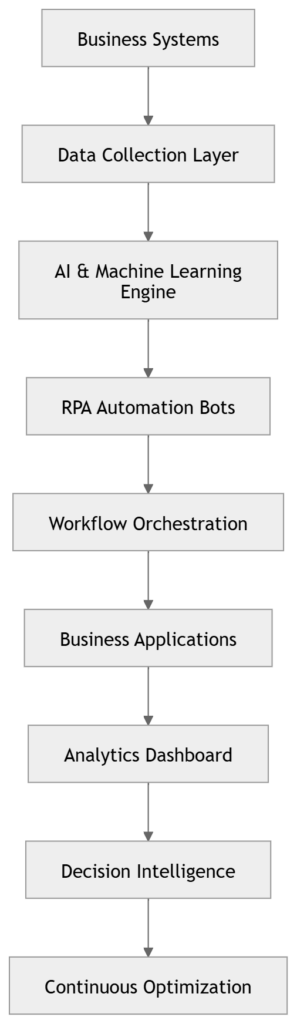
How AI and Automation Work Together
Artificial intelligence enhances automation by enabling systems to interpret data, identify patterns, and make contextual decisions.
Traditional automation handles predictable workflows. AI-powered automation adapts dynamically to changing scenarios.
Example
| Traditional Automation | Intelligent Automation |
|---|---|
| Follows fixed rules | Learns from patterns |
| Limited adaptability | Dynamic decision-making |
| Requires manual updates | Self-improving models |
| Handles structured data | Processes structured and unstructured data |
Common Challenges Solved by Automation
Manual Data Entry Errors
Automation eliminates repetitive input tasks and improves data integrity.
Slow Operational Workflows
Processes that previously required days can be completed within minutes.
Fragmented Systems
Automation integrates disconnected software platforms into a centralized ecosystem.
Workforce Scalability Limitations
Businesses scale operations without proportionally increasing staffing costs.
Future Trends in Intelligent Automation
Hyperautomation
Organizations are combining AI, RPA, analytics, and low-code platforms to automate entire business ecosystems.
AI-Powered Decision Automation
Advanced machine learning models will increasingly support autonomous business decisions.
Conversational Automation
AI assistants and voice-enabled systems will transform customer engagement and workplace productivity.
Autonomous Business Operations
Businesses are moving toward self-operating systems capable of real-time optimization and predictive execution.
Choosing the Right Automation Partner
Selecting an automation provider requires evaluating:
- Technical expertise
- Industry experience
- Security standards
- Scalability capabilities
- AI integration expertise
- Long-term support services
A strategic automation partner ensures technology investments deliver measurable business outcomes.
Why Businesses Invest in Intelligent Automation
Organizations adopting intelligent automation achieve:
- Lower operational costs
- Faster service delivery
- Higher customer satisfaction
- Improved compliance
- Better workforce utilization
- Increased competitive advantage
Automation is no longer optional for businesses seeking sustainable growth and operational excellence.
Conclusion
Intelligent automation services transform how businesses operate by combining AI machine learning, and robotic process automation into scalable digital ecosystems. From finance and healthcare to retail and manufacturing, automation improves efficiency, accuracy, customer experiences, and long-term profitability.
Businesses that embrace intelligent automation gain the agility necessary to compete in rapidly evolving markets while positioning themselves for future innovation and scalable growth.